
It’s 4:45 p.m. and it’s already dark.
You planned to fold the laundry, answer those three emails, and make a real dinner. Instead you’re on the couch, half-scrolling, wondering why everything feels so heavy.
In the summer you could keep all the plates spinning. Now even small tasks feel like wading through mud. Your focus is gone, your mood is flat, and the anxious inner voice is louder than ever: Why can’t I just get it together?
If you’re a woman with ADHD, especially high-functioning or late-diagnosed ADHD, this could be your brain reacting to the light, not a personal failure. You aren’t lazy and you aren’t imagining it. Winter really does hit ADHD brains harder, and there’s research to explain why.

Some resources mentioned may include affiliate links, including Amazon. As an Amazon Associate, I earn from qualifying purchases, and I may also earn a small commission through other affiliate partners, at no additional cost to you. I only recommend products and books that align with evidence-informed ADHD support and relational health practices. Thanks for supporting my small business!
Table of Contents
What’s Actually Happening: Light, Your Body Clock, and Your Brain
Your body runs on a roughly 24-hour internal clock called your circadian rhythm. It decides when you feel alert, when you feel sleepy, and when hormones like melatonin (the “time for bed” hormone) and cortisol (the “time to get up” hormone) rise and fall.
Morning light is the main thing that keeps this clock set. When bright light reaches special cells in your eyes, it tells your brain, “It’s daytime. Wake up, stop making melatonin, and get going.”
In winter that signal gets weak. Days are shorter, the sun is lower and dimmer, and most of us spend daylight hours indoors. For scale, a regular indoor room is usually a few hundred lux (lux measures how bright light is). A cloudy winter day outside is often several thousand lux, and a sunny day can be 50,000 or more. So you can spend a whole day “in the light” and your brain still reads it as dusk.
When the clock doesn’t get a clear morning signal, it tends to drift later. Melatonin hangs around in the morning, you feel groggy and foggy, and it gets harder to fall asleep at night. For a lot of people this is where the winter blues come from. For some it becomes Seasonal Affective Disorder (SAD), a type of depression that returns at the same time each year, usually fall and winter.
Why ADHD Brains Feel It More
This is the part that matters for you. ADHD brains already start the race behind on light and sleep.
Most adults with ADHD already have a delayed body clock. In a 2010 Dutch study of adults with ADHD and trouble falling asleep, about 78% had a delayed melatonin rhythm, meaning their bodies started making melatonin later than typical. A brain that’s already running late gets pushed even later when winter takes away its morning light.
ADHD and seasonal mood dips overlap. Studies have found ADHD and SAD showing up together more often than chance would predict. One study of adults with SAD found high rates of childhood ADHD symptoms. Researchers think shared problems with circadian timing and dopamine may be part of the reason.
Sunlight and ADHD rates may be connected. A 2013 study in Biological Psychiatry found that U.S. states and countries with stronger sunlight had lower rates of ADHD diagnosis. The researchers suggested that more natural light may help protect sleep and body-clock timing. That doesn’t mean sunshine prevents ADHD. It does add to the evidence that light and ADHD are tied together.
Winter drains your dopamine sources. ADHD brains are always hunting for dopamine, the chemical tied to motivation, reward, and getting started. In winter we lose many of our easy dopamine hits: time outside, movement, sunshine, social plans, novelty. Less dopamine means more ADHD paralysis, where you know what to do and still can’t make yourself start.
Then the anxiety stacks on top. When focus slips, the overfunctioner in you tries to cover the gap with more lists, more pushing, and more self-criticism. That’s the fast track to ADHD burnout. Being tired and wired is exhausting.
So if winter has you feeling like a dimmer version of yourself, that’s a biological pattern you can work with, not a character flaw.

Light Therapy: What the Research Says
Bright light therapy means sitting near a special lamp, usually one that gives off 10,000 lux, for a set amount of time each morning. It’s one of the most studied treatments for seasonal depression, and more and more research is looking at how it helps ADHD.
In a 2006 study published in the Journal of Clinical Psychiatry, adults with ADHD used a bright light every morning for three weeks. By the end, both their ADHD symptoms and their mood had improved. The people whose body clocks shifted earlier saw the biggest changes.
A 2017 pilot study published in Psychiatry Research found something similar. Adults with ADHD used bright light in the morning for two weeks, and their body clocks shifted earlier. That shift predicted how much their ADHD symptoms improved, including both inattention and hyperactivity.
These were small studies, and light therapy isn’t a replacement for medication or treatment. The pattern is still encouraging: when light helps reset your body clock, ADHD symptoms often ease. It’s also inexpensive, takes very little effort, and fits right into the time you already spend drinking your morning coffee.
How to Use a Therapy Light (Without Overthinking It)
When to start: Early fall, before the dip arrives. If you’re reading this mid-winter, start now. It isn’t too late. Most people notice a difference within one to two weeks.
When to use it: Within the first hour after waking. Morning is the key. Using it in the evening can push your clock later, which is the opposite of what an ADHD brain needs.
How long: Start with 20 to 30 minutes a day. Some people need a little more. Stay consistent instead of going longer.
How to sit: Put the light off to the side at about eye level, angled toward your face. Don’t stare into it. It just needs to reach your eyes while you do something else. Check your lamp’s manual for the right distance, because 10,000 lux only works at a certain range, usually closer than people expect.
Stack it with something you already do. This is the ADHD hack. If light therapy is a separate task, you’ll forget it by Thursday. Put the lamp exactly where you already sit each morning: next to the coffee maker, on your desk, or by the spot where you check your phone. Turn it on at the same moment as the coffee. No extra decisions.
When to talk to your doctor first: If you have bipolar disorder (bright light can trigger mania), eye conditions like macular degeneration or glaucoma, or take medications that make you sensitive to light, check with your provider before you start. If your low mood is serious or you’re struggling to function, light therapy is a support, not a substitute for care.
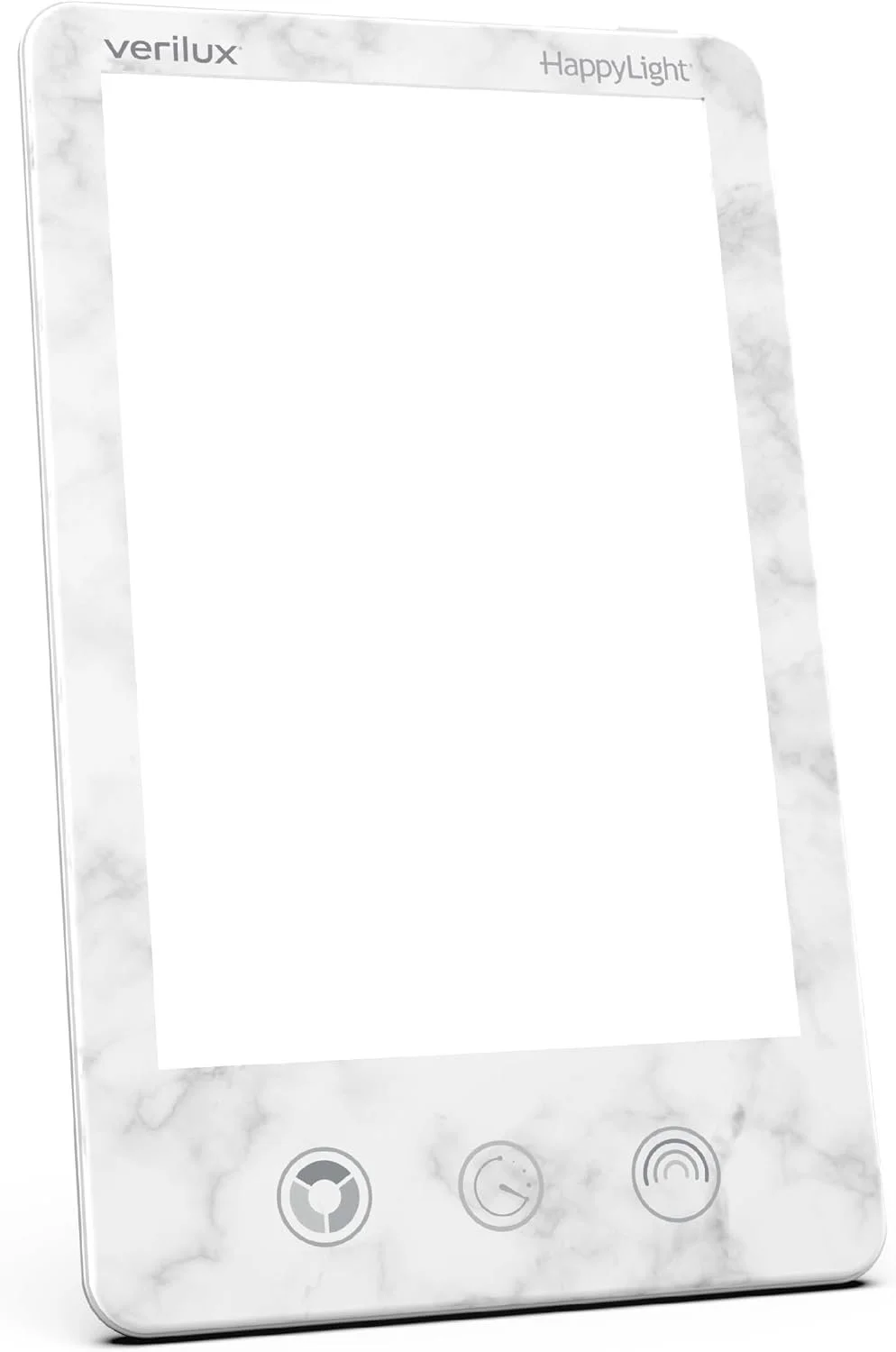
The Light I Recommend: Verilux HappyLight Luxe
If you’re only going to buy one therapy light, I’d go with the Verilux HappyLight Luxe. There are plenty of light therapy lamps out there, and many of them work fine on paper. What matters for an ADHD brain is whether you’ll actually use it every morning, not just for the first week while it’s new and exciting. That’s where this one stands out.
Here’s why it fits the way an ADHD brain works:
It gives off 10,000 lux of UV-free LED light. That’s the same brightness used in the research on light therapy and seasonal mood. It’s bright enough to send a clear “it’s morning” signal to your brain. It also filters out UV rays, so you get the benefits of bright light without the skin damage that comes with sun exposure.
It has a built-in countdown timer. This might be the most important feature for ADHD. You don’t have to remember to turn it off, watch the clock, or set a separate phone alarm that you’ll swipe away and forget about. Turn it on, set the timer, and go about your morning. When your session is done, it shuts off on its own. Fewer decisions and fewer things to remember mean you’re much more likely to stick with it.
You can adjust the brightness and color temperature. On groggy mornings, a blast of bright white light can feel like a lot. With the HappyLight Luxe, you can start at a lower setting and work your way up, or choose a warmer tone that feels less harsh and clinical. That flexibility makes the habit easier to start and more pleasant to keep, which matters when your brain resists anything that feels like a chore.
Its slim design looks like a tablet. It doesn’t take up much space, so it fits easily on a kitchen counter, desk, or nightstand. That might sound like a small detail, but for ADHD it’s a big one. If your therapy light lives in a closet or a corner you never sit in, you’ll forget it exists. When it sits right where your morning already happens, next to the coffee maker or your laptop, it becomes part of your routine instead of one more thing on your to-do list. With ADHD, out of sight really is out of mind.
Other Ways to Support Your ADHD Brain This Winter
A therapy light can make a real difference, but it works best as one piece of a bigger winter plan. These free strategies support the same things the light does: your body clock, your sleep, and your dopamine. Some of them work even better than a lamp because they support more than one of those at once. You don’t need to do all of them. Pick one or two that feel doable and start there.
1. Get outside within an hour of waking, even when it’s gray.
Outdoor light is much stronger than most people realize, even on a cloudy winter day. A short walk on an overcast morning can give your eyes many times more light than sitting in a well-lit kitchen. That morning light is one of the strongest signals your body clock gets, and it helps you feel more awake now and sleepier at the right time tonight. You don’t need a big outdoor routine. Walk the dog, walk to the mailbox, or drink your coffee on the porch wrapped in a big coat. Even 10 minutes counts.
2. Keep your wake-up time steady.
The ADHD body clock already tends to drift later, and winter makes it drift even more. One of the best ways to anchor it is to wake up at about the same time every day, including weekends. It’s tempting to sleep in on Saturday to “catch up,” but a big shift in your wake time can leave you feeling jet-lagged by Monday. If you’re going to focus on one sleep habit, focus on your wake-up time first. When your mornings are consistent, bedtime usually falls into place over time.
3. Dim things down at night.
Just as bright light in the morning tells your brain it’s daytime, bright light at night tells it the day isn’t over yet. Overhead lights and screens in the evening can push your body clock even later, making it harder to fall asleep and harder to wake up. After dinner, try switching off the overhead lights and using lamps instead. A warm, dimmable lamp gives your brain a gentle cue that it’s time to wind down. Think of morning light and evening dimness as a team: one turns the day on, and the other helps turn it off.
4. Ask your doctor about your vitamin D.
Your body makes vitamin D when your skin is exposed to sunlight. In winter, especially in northern states, the sun is often too low in the sky for your skin to make much of it at all. That’s why so many people run low during the colder months. Low vitamin D has been linked to fatigue and low mood. Instead of guessing, ask your doctor for a simple blood test. If your levels are low, they can recommend the right supplement and dose for you.
5. Build a winter dopamine menu.
A dopamine menu is a short, ready-made list of quick activities that give your brain a little boost when you feel stuck. It works because when you’re in that foggy, frozen place, coming up with ideas is hard. A list means you don’t have to. Make yours specific to winter, with cozy options that work in the dark months. A 5-minute dance break in the kitchen, a new podcast, a favorite snack, a long warm shower, texting a friend, or a small craft project can all go on the list. Keep it somewhere you’ll see it, like the fridge or your phone’s lock screen. When you feel stuck, pick something from the menu instead of waiting for motivation to show up on its own.
6. Move your body, even a little.
Movement is one of the fastest natural ways to boost dopamine and help your brain focus. In winter, cold and darkness make it easy to stay on the couch, so the goal here isn’t a perfect workout routine. It’s just to move. Do ten squats while the kettle boils. Have a dance party while you unload the dishwasher. Stretch on the floor while you watch TV. Small bursts of movement add up, and they often make it easier to start the task you’ve been avoiding.
7. Lower the bar on purpose.
This one is hard for overfunctioners, so let’s be clear about it: you’re working with less light, less dopamine, and often less sleep in winter. Expecting yourself to perform at summer levels in January sets you up for anxiety, guilt, and ADHD burnout. Lowering the bar isn’t giving up. It’s adjusting your plan to fit your real capacity. Each morning, pick the three things that truly need to happen that day. Everything else is extra credit. When you finish your three, you’ve had a successful day, even if the laundry is still sitting in the basket.
8. Plan small reasons to leave the house.
Winter can get isolating fast, especially for brains that thrive on connection and novelty. When it’s dark at 5 p.m., “we should get together sometime” almost never happens. Instead, put small, specific plans on the calendar: a coffee date on Thursday morning, a library trip on Saturday, a walk with a friend after school drop-off. They don’t have to be big outings. A reason to get dressed, get outside, and see another person can lift your mood more than you’d expect.
If you want a simple, repeatable plan for the days when your brain just won’t get going, my ADHD Reset Sequence workbook walks you through five steps to get unstuck without white-knuckling it. It’s designed for exactly those moments when you know what you need to do but can’t seem to start, which makes it a great companion on gray winter mornings. Find it here.
You’re Not Broken. You’re Running Low on Light.
If winter makes you feel like a shadow of yourself, that feeling is real, and it isn’t a sign that you’re failing. Your brain is reacting to real changes in light, sleep, and dopamine. For an ADHD brain that already runs on a later body clock and is always looking for more dopamine, those changes hit harder. That isn’t a character flaw. It’s biology.
The good news is that you don’t have to white-knuckle your way to spring. Once you understand what’s happening, you can give your brain what it’s missing. You need tools that fit how your ADHD brain works, especially when the days get short.
Start small. Put a therapy light next to your coffee maker. Step outside for a few minutes in the morning. Keep your wake-up time steady. Lower the bar a little and give yourself credit for what you get done. Then pay attention to how you feel over the next couple of weeks. Small changes, done consistently, can make this winter feel very different from the last one.
For more about ADHD in women, late-diagnosed ADHD, and real tools that fit your brain, keep reading the blog. You’ll find more posts on ADHD and anxiety, burnout, and getting unstuck when your brain won’t cooperate.
*The information in this article is for educational purposes only and should not replace medical advice. If you think you may have ADHD, talk with a qualified healthcare professional about a comprehensive evaluation.*

Shannon Keleher is a Licensed Clinical Social Worker (LCSW), Certified ADHD Clinical Services Provider (ADHD-CCSP), and Certified Mental Health & Nutrition Clinical Specialist (CMNCS) specializing in helping women with ADHD navigate anxiety, executive functioning challenges, and the overwhelm of high-functioning ADHD. Through evidence-based education and compassionate support, she empowers women to better understand their brains and build lives that work with them—not against them. For more research-backed insights on ADHD in women, anxiety, and executive functioning, follow her on Instagram at @unmaskedadhdtherapist or subscribe to her newsletter.